TL;DR
Short version: the question is not whether a cream can help. It is which layer the problem lives in, because that decides whether anything topical can reach it at all. |

A shelf like this one solves some eye-area complaints completely. The trouble is that it solves a narrower set than most people assume.
Almost every patient who asks about eye creams has already tried several. That is worth taking seriously rather than treating as a failure of product choice. When a reasonable routine has been used consistently for an appropriate trial and nothing has shifted, the most useful next step is usually not another formulation. It is working out which anatomical layer the complaint actually sits in.
What skincare genuinely improves
There is a real list here, and it is not short.
Fine lines from dehydration and sun damage respond to consistent sunscreen, retinoids used carefully at low strength, and simple occlusion at night. Pigmented dark circles, the brown kind that darken in sunlight and run in families, respond to pigment-directed actives and rigorous photoprotection. Puffiness that is worse on waking and settles by midday is fluid, and it responds to sleep position, salt, allergy control and time. Crepey texture improves with barrier repair.
Give suitable treatments a consistent trial appropriate to the ingredient and condition; some need weeks and others longer. Follow product directions and seek professional advice if irritation develops or symptoms persist.
Where topicals stop
A cream is a topical agent applied to skin roughly half a millimetre thick. Several of the things people ask it to fix are not in that half millimetre.
Excess upper lid skin sits in the skin and the muscle beneath it. A drooping lid margin is a muscle and tendon problem. Under-eye bags are orbital fat that has pushed forward through a weakening septum, with a tear trough hollow below making the bulge look worse by contrast. A low brow reflects brow position and soft tissue descent across the forehead, influenced by the underlying anatomy. None of these is reachable by anything applied to the surface, at any price.
Non-surgical treatments extend the range somewhat. Fillers can soften a tear trough. Botulinum toxin can lift a lateral brow a few millimetres. Energy devices tighten skin modestly. All of them work at the margins of a structural problem, and none of them removes tissue or repositions a muscle.
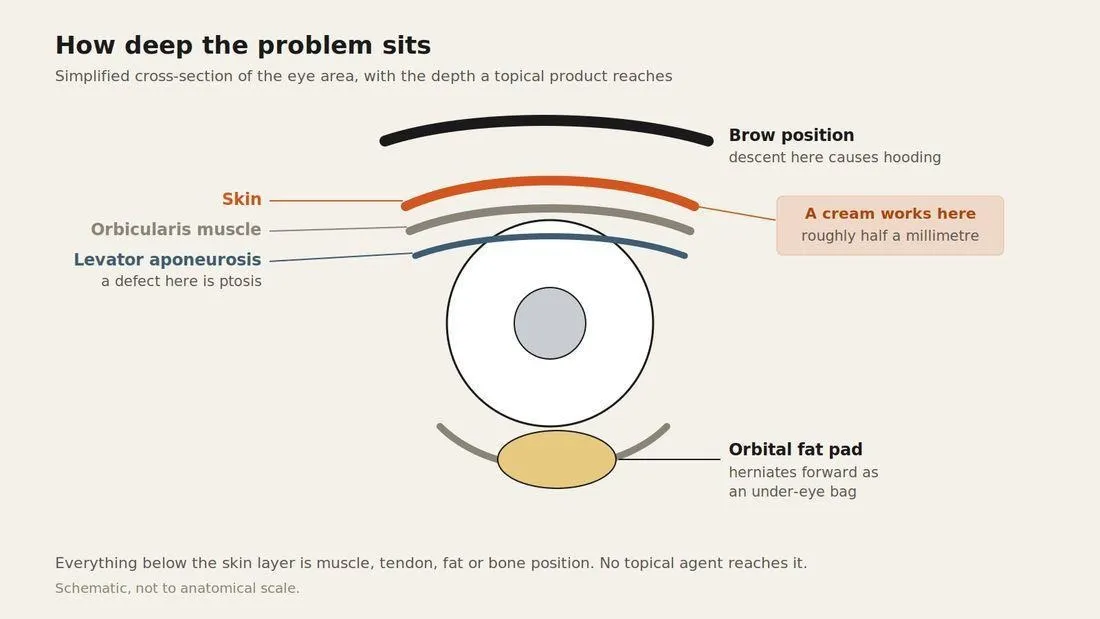
A cream works in the top layer only. Everything commonly described as hooding, drooping or bags sits below it.
The surgical menu is wider than upper blepharoplasty
This is where the conversation usually goes wrong. Upper blepharoplasty, meaning removal of excess upper lid skin, has become shorthand for eye surgery generally, and it is only one entry on a longer list.
A clinic offering the full range of Korean eye surgery procedures will separate at least six of them: double eyelid surgery in incisional and non-incisional forms, ptosis correction in both forms, lower eyelid surgery, canthoplasty to alter the outer corner, mid-aged eyelid surgery combining upper blepharoplasty with lower blepharoplasty and browpexy, and revision surgery for eyes operated on before. They are not interchangeable, and the reason to know the list is that it tells you what a proper assessment should have ruled in or out.
For scale on the recovery involved, stitches typically come out at 7 to 8 days, swelling settles over 2 to 4 weeks, and the final appearance takes 3 to 6 months.
Hooding, ptosis and bags are three different diagnoses
They look similar in a mirror and they are treated differently.
Dermatochalasis is redundant, lax upper lid skin and muscle, caused by loss of elastic tissue and thinning of the epidermis. The lid margin itself sits where it should. Skin is the problem here, so removing skin is the answer.
Blepharoptosis is different. Here the lid margin itself sits low, because of a defect in the levator muscle that raises it. It can arrive with simple ageing or injury, and it can also signal myasthenia gravis, third nerve palsy or a mass weighing the lid down, which is exactly why it warrants examination rather than a cosmetic consultation. Moorfields Eye Hospital notes that a low upper lid "can interfere with vision by affecting the top part of your visual field," alongside eyestrain and brow ache from the constant effort of holding the lid up.
Then there is brow ptosis, where the eyebrow has descended and pushes lid tissue down in front of it. Clinically this is the trap. Temporal hooding is often a combination of lateral brow descent and lid skin laxity, and the StatPearls chapter on upper eyelid blepharoplasty warns that "when upper eyelid surgery is performed with or without ptosis repair, the position of the brows will drop, unmasking the brow ptosis." Operate on the lid alone and you can end up with a worse brow than you started with.
True under-eye bags are herniated orbital fat. Not fluid, not pigment, and nothing applied to the surface moves them.
The distinction is measured rather than eyeballed. One cited reference reports a corneal reflex-to-lid margin distance of 3.5 to 4 mm in Caucasian patients. A reading below 3 mm, or asymmetry between the two sides, prompts formal ptosis assessment rather than automatic treatment; reference values must be interpreted in the context of the patient's anatomy and population.
Suitability, and the risks nobody leads with
Surgery around the eye is not a default upgrade from skincare. Dry eye disease is the most common reason to slow down, because lid surgery can worsen it and some patients need it managed first. Thyroid eye disease, uncontrolled diabetes, bleeding disorders and unrealistic expectations all change the calculation. Any sudden or one-sided lid droop is a neurological question before it is a cosmetic one, and it needs seeing quickly.
Known risks include dry eye, asymmetry, over-correction and under-correction, scarring, and in lower lid surgery a pulled-down lid margin. Revision exists as a category because these outcomes happen to careful surgeons.
What a proper assessment looks like
You are looking for measurement, not reassurance. A thorough examination records levator function, margin reflex distance, brow position, lid symmetry, tear film quality and Bell's phenomenon, and takes an ocular history covering previous surgery, dryness and blepharitis. It should also separate what is skin, what is muscle, what is fat and what is brow, and say so plainly.
If you want the diagnostic groundwork done first, a dermatologist can help assess pigment, irritation, allergy and some causes of puffiness, which may account for the complaint. Credihealth's guide to how to get rid of bags under eyes and dark circles is a sensible starting point for exactly that. What it cannot do, and no topical assessment can, is tell you where a lid margin sits in millimetres.
That number is the one that decides whether this was ever a skincare problem.

Reviewed by