Key Takeaways
Read the label and search the exact product name before buying.
Avoid prescription-like claims, vague blends, and unclear seller details.
Check FDA alerts, brand history, UPC, lot number, and packaging match when available.
Treat 'no alert found' as unknown, not as a guarantee of safety.
Talk to a healthcare professional if you take heart, blood-pressure, nitrate, or ED medications.
HoneyPackFinder.com helps shoppers compare brands, alerts, product records, and safety context.
Honey packs are easy to buy, easy to carry, and easy to misunderstand. To many consumers, a small honey sachet or packet looks more like a food item than a supplement. That is part of the appeal, but it can also create a false sense of safety when the product is marketed for stamina, performance, or male enhancement.
The goal of this checklist is not to scare consumers away from every honey-based product. Honey itself is not the issue. The concern is that some honey-based products promoted for sexual enhancement or performance have been found with undeclared drug ingredients. The U.S. Food and Drug Administration
has warned that tainted honey-based products may contain hidden active drug ingredients such as sildenafil or tadalafil, and that those ingredients can create dangerous interactions with nitrates and certain cardiovascular medications.
A safer purchase starts with a slower purchase. Instead of relying on a bold package, online review, social-media clip, or store recommendation, shoppers should take a few minutes to verify what they can. A simple checklist can help separate transparent products from products that depend on hype, vague labels, or incomplete information.
Why a Checklist Matters
The honey pack market can be confusing. Similar product names, changing packaging, reseller listings, and incomplete manufacturer details make it difficult to know whether two products are the same item, related items, or unrelated products with similar branding.
That matters because an alert, recall, or lab finding may apply to a specific product, package size, lot, UPC, or distributor. If a consumer searches only a partial brand name, they may miss relevant information. If they assume that a similar package is identical, they may misunderstand the risk history. Good research requires matching details as closely as possible.
The FDA's sexual-enhancement and energy product notification page exists to help consumers learn about products found with hidden ingredients, but the agency also notes that this category involves products sold online, in stores, and through changing marketplaces. For shoppers, the practical takeaway is simple: do not wait until after a purchase to ask basic safety questions.
Step 1: Match the Exact Product Name
Start with the full product name exactly as it appears on the package or listing. Include spelling, punctuation, package color, size, and any words such as 'extra strength,' 'VIP,' 'royal,' 'black,' 'max,' or 'for men.' These details may seem small, but they can change the search result.
Next, look for the UPC, lot number, expiration date, manufacturer, importer, and distributor. If those fields are missing, that is useful information too. Missing traceability details do not automatically prove a product is unsafe, but they do make verification harder.
When using a search tool, compare images and package format. A product sold in a 10 gram sachet may not be the same as a product sold in a jar, box, syringe, or bundle pack. If the exact product cannot be matched, treat the result as uncertain.
Step 2: Read the Label Like a Supplement Label
Even when a product looks like ordinary honey, read it like a supplement. Look for a full ingredient list, serving size, amount per serving, warnings, suggested use, manufacturer information, and contact details. A label that gives consumers clear information is easier to evaluate than one that relies on broad claims and mystery blends.
Be cautious with vague phrases such as 'proprietary blend,' 'secret formula,' 'natural performance complex,' or 'herbal power blend' when they appear without clear ingredient names or amounts. Proprietary blends are common in supplements, but when paired with strong performance claims and little traceability, they deserve closer review.
Also pay attention to what the label does not say. Does it identify the manufacturer or only a reseller? Does it include warnings for people taking medication? Does it provide a batch or lot number? Does the product page match the package image? The safest-looking design is not the same as a transparent label.
Step 3: Check FDA Alerts and Warning History
Before buying, search FDA public notifications, recall notices, and warning history related to the exact product name or brand family. The FDA has identified hidden drug ingredients in multiple
sexual-enhancement and energy products, including honey-based products.
One FDA notice for Secret Miracle Honey Extra Strength reported laboratory analysis that found sildenafil, tadalafil, and acetaminophen that were not listed on the label. The FDA advised consumers not to purchase or use that product. Findings like that show why consumers should not treat 'natural' or 'honey-based' marketing as proof of safety.
A key point: an FDA alert is strong evidence that a product was a concern, but the absence of an alert is not proof that a product is safe. Regulators cannot test every product in every package, lot, marketplace, or resale channel. A no-match result should be viewed as unknown, not cleared.
Step 4: Be Skeptical of Prescription-Like Claims
Marketing language is one of the easiest places to spot risk. Consumers should be cautious with products that promise instant results, extreme potency, guaranteed performance, or effects that sound similar to prescription erectile-dysfunction medication. A product promoted as a food or supplement should not imply that it works like an undeclared drug.
This does not mean every energetic phrase is illegal or unsafe. It means the stronger the promise, the more important verification becomes. If the product claims to work immediately, last for a specific number of hours, or create unusually strong physical effects, shoppers should ask what ingredient could plausibly create that result and whether the label explains it.
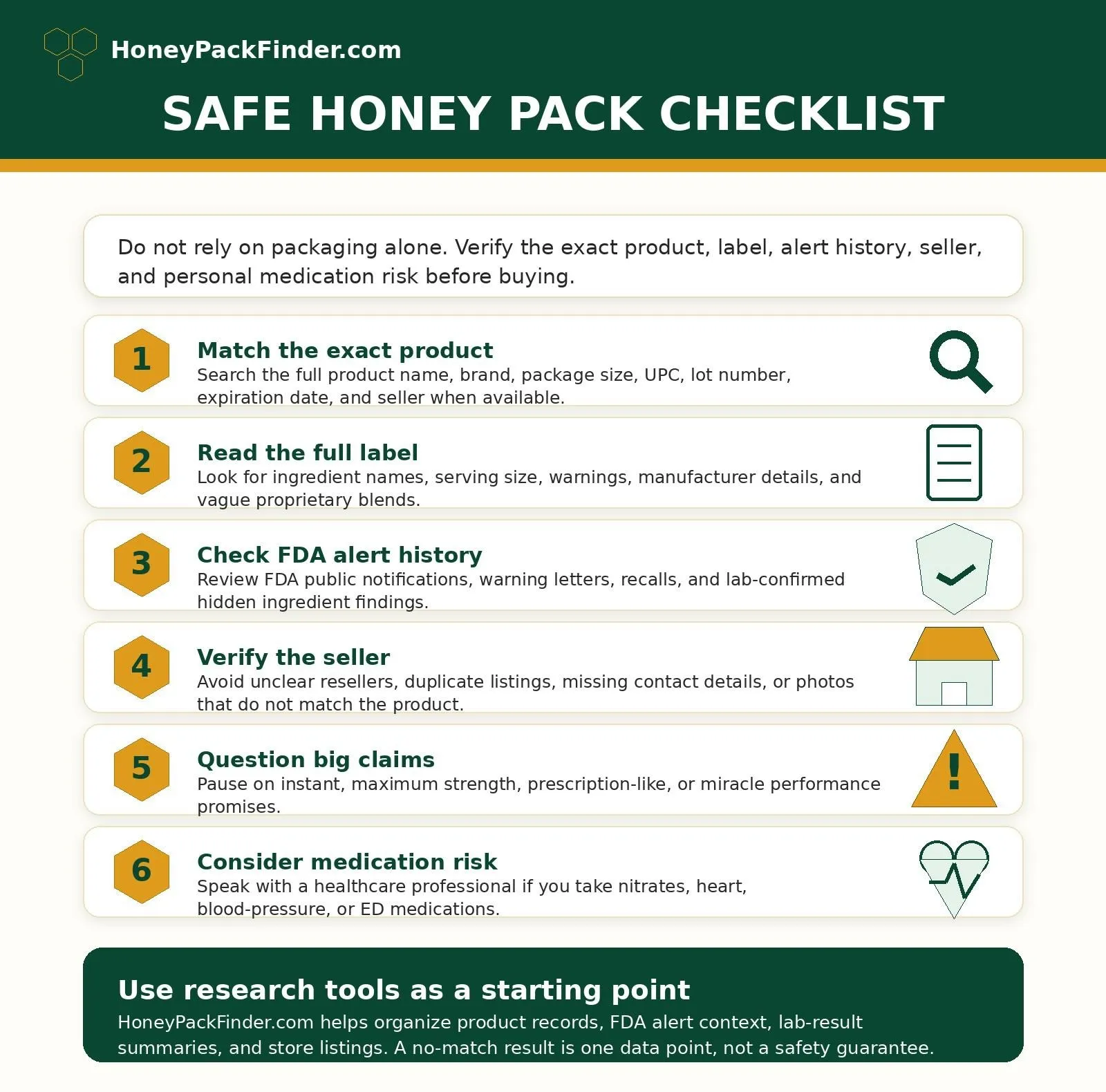
Infographic: A practical safety checklist for researching honey packs before purchase.
Step 5: Verify the Seller and the Supply Chain
A honey pack may move through several hands before reaching a consumer: manufacturer, importer, distributor, wholesaler, marketplace seller, smoke shop, convenience store, or online retailer. Each step can introduce confusion, especially when listings copy product photos, use outdated packaging, or combine multiple brand names.
Look for seller details such as company name, address, return policy, contact email, and
product-specific photos. Be careful with listings that use generic images, blurry labels, or inconsistent descriptions. If a seller cannot identify the product clearly, consumers have less ability to research its
history.
Retailers should also do their own due diligence before placing products on shelves. Responsible sellers should know where the product came from, what lot they are selling, whether the label matches the invoice, and whether the brand has appeared in public alert records.
Step 6: Look for Transparency and Testing
Transparent brands make it easier for consumers to evaluate risk. Useful signals include a clear ingredient list, responsible claims, batch or lot traceability, manufacturing information, and testing documentation. Testing does not eliminate every risk, but it can show that a company is willing to verify what it sells.
For honey-based supplements, relevant documentation may include ingredient certificates of analysis, contaminant testing, adulterant screening, microbial testing, heavy-metals testing, and finished-product specifications. Consumers may not always have access to all of these documents, but brands that provide at least some verifiable documentation are easier to evaluate than brands that provide none.
The same rule applies to retailers and directories. Safety tools should separate levels of evidence instead of treating every mention as equal. HoneyPackFinder describes itself as a consumer-safety directory that combines store listings, FDA enforcement records, lab-result summaries, and
harm-reduction guidance so shoppers can review product and brand context.
Step 7: Consider Personal Health and Medication Risk
The same product can carry different levels of risk for different people. A consumer taking nitrates, heart medication, blood-pressure medication, alpha-blockers, erectile-dysfunction medication, or multiple prescriptions should be especially careful with performance supplements. The FDA warns that hidden sildenafil or tadalafil can interact with nitrates and lower blood pressure to dangerous levels.
People with cardiovascular conditions, diabetes, high blood pressure, or high cholesterol should not rely on a product label alone to judge risk. A healthcare professional can help evaluate whether a supplement could interact with medications or underlying conditions.
Consumers should also pay attention to side effects. If someone experiences chest pain, dizziness, fainting, severe headache, vision changes, a major blood-pressure change, or any unexpected reaction after using a honey pack, they should stop using the product and seek medical help. Serious adverse events can be reported to FDA MedWatch.
Step 8: Use HoneyPackFinder as a Research Starting Point
HoneyPackFinder.com is useful because the category is fragmented. A consumer may find a product in a local store, see it on a marketplace, then discover that similar names appear in FDA notices or
lab-result summaries. Bringing those records into one research flow can help shoppers pause before buying.
HoneyPackFinder's FDA alert lookup tool advises users to search by product name, brand, UPC, lot number, or ingredient. It also warns that no match in HoneyPackFinder data does not mean a product is safe, unadulterated, FDA-approved, or currently legal to sell. That caveat is important because a
safety tool should inform consumers without creating false certainty.
The best use of a directory is not to ask, 'Can I buy this without thinking?' It is to ask, 'What do the available records show, and what is still unknown?' That mindset helps consumers make better decisions and helps responsible brands stand out.
A Quick Consumer Checklist
Can I identify the exact product? | Full product name, package size, UPC, lot, expiration date, and current package image. |
Is the label clear? | Ingredient list, serving size, warnings, manufacturer, distributor, and contact details. |
Does it make drug-like claims? | Instant results, guaranteed performance, extreme potency, or prescription-like wording. |
Has it appeared in alerts? | FDA notices, recalls, warning letters, HoneyPackFinder records, or lab-result summaries. |
Is the seller credible? | Clear business details, current product photos, return policy, and no mismatched listings. |
Do I have health risks? | Medication use, heart or blood-pressure concerns, nitrate use, or existing ED medication use. |
What Responsible Brands Should Make Easy
A safer market depends on responsible brands as much as cautious consumers. Brands should make it easy to identify the product, understand the ingredients, find the manufacturer or distributor, and see whether the batch has supporting documentation.
Responsible marketing should avoid implying that a supplement works like a prescription medication. Claims should be specific, supportable, and appropriate for the product category. The stronger the claim, the stronger the evidence should be.
Responsible brands should also be prepared for questions. If consumers or retailers ask for documentation, the answer should not be confusion or silence. Clear documentation builds trust, and trust is especially important in a category where hidden ingredient warnings have already affected consumer confidence.
Conclusion
Choosing a honey pack should involve more than liking the package or trusting the word 'natural.' Some honey-based products marketed for performance or sexual enhancement have been found with hidden drug ingredients, and those ingredients can create serious risks for people taking certain medications.
A practical checklist helps consumers slow down and verify what they can. Match the exact product name, read the label, check FDA alerts, review seller details, question prescription-like claims, and consider personal medication risks. If the information is incomplete, treat that uncertainty as part of the decision.
HoneyPackFinder.com gives shoppers a practical place to begin by organizing product records, FDA alert context, brand information, lab-result summaries, and safety guidance. It is not a medical clearance or a guarantee, but it can help consumers ask better questions before buying.
The best honey pack purchase is not the fastest one. It is the one made with clear information, responsible expectations, and a label that can withstand a closer look.
Frequently Asked Questions
Are all honey packs dangerous?
No. Honey itself is not the problem, and not every honey-based product is dangerous. The concern is with products that make performance or sexual-enhancement claims while failing to clearly disclose what they contain.
What is the first thing I should check?
Start with the exact product name, package size, UPC, lot number, and seller. Accurate matching helps avoid confusing one product with another.
What label details matter most?
Look for a full ingredient list, serving size, warnings, manufacturer or distributor information, contact details, and lot or batch information.
Why are hidden sildenafil or tadalafil findings so serious?
Consumers may unknowingly take a drug ingredient without knowing the dose, side effects, or medication interactions. The FDA warns that hidden sildenafil or tadalafil may interact with nitrates and lower blood pressure to dangerous levels.
Does a no-match search result mean a honey pack is safe?
No. A no-match result means no matching record was found in that database. HoneyPackFinder's own alert lookup warns that no match does not mean a product is safe, unadulterated, FDA-approved, or currently legal to sell.
Can professional packaging prove safety?
No. Good design, shiny packaging, online reviews, or words like 'natural' do not prove that a product is safe or fully disclosed.
Should people taking medication use honey packs?
Anyone taking nitrates, heart medication, blood-pressure medication, ED medication, or multiple prescriptions should speak with a licensed healthcare professional before using performance supplements.
How does HoneyPackFinder help?
HoneyPackFinder helps consumers research honey-pack brands, product records, FDA alerts, lab-result summaries, and safety context before making a purchase decision.

Reviewed by