Britain’s Office Epidemic No One Talks About
Did you know that each year, more than 470,000 workers in Britain suffer from work-related musculoskeletal disorders, according to recent Health and Safety Executive data (HSE, 2023)?
The consequence is not merely discomfort; it is economic drag.
An estimated 7- 8 million working days are lost annually due to these conditions.
Within the broader category of musculoskeletal disorders UK-wide, lower back pain remains dominant.
The UK’s NHS continues to shoulder significant diagnostic, imaging and physiotherapy demand linked to spinal complaints (NHS, 2023). The cost to the UK economy runs into the billions due to absence, reduced output, and long-term disability claims (ONS, 2023).
Yet in many London offices, this issue is normalised. Workplace back pain in the UK is often framed as “just part of the job.” The phrase “office-related back pain” has become almost casual, a background inconvenience rather than a performance constraint.
The reality is stark: this is not a gym issue.
It is a productivity issue.
The cumulative productivity loss due to back pain affects concentration, morale and decision-making capacity at scale.
Lower back pain at work is rarely solved by a silver bullet, yet the belief persists.
Therefore, a recurring question in occupational health discussions is: What is the single best exercise for lower back pain?
However, the more important question may be: why are so many employees needing one?
Why Office Back Pain Is Biomechanical - and Why Rehabilitation Must Be Multifactorial
Lower back pain in office professionals is not always caused by a single traumatic event.
More commonly, it is the outcome of a sustained poor habitual environment, repetitive movements creating asymmetric muscular imbalances, postural, core weaknesses, sitting and significant biomechanical musculoskeletal inefficiency.
Prolonged seated spinal flexion inhibits some of your hip’s muscles, tightens your hip flexors, weakens deep stabilising musculature, particularly the gluteus complex, pelvic floor muscles, transverse abdominis, multifidus, whilst compressing the piriformis muscle – all together reducing spinal stability.
Over time, the cumulative effect reduces your spine muscles' support, spinal stability, increases intervertebral disc pressure, and amplifies compensatory muscular imbalances.
Lower back rehabilitation is often perceived as complex - and rightly so.
Once the spine has been injured, the problem is rarely isolated to a single structure.
Back pain alters movement patterns, disrupts neuromuscular control and reduces load tolerance, creating a cascade of compensations throughout the kinetic chain.
Office Back Pain Is a System Failure - and Rehabilitation Must Rebuild the System
So, why does rehabilitation seem so complex once the spine has been injured?
“Effective lower back pain rehabilitation is inherently multifactorial; therefore, it must prioritise not only the customised stretching and strengthening of the hips, core, spinal erectors and deep spinalis muscles, but also neuromuscular retraining to restore and normalise lost muscular function and its neurology, maximise hip range of motion (ROM) and movement biomechanics, reactivate posterior chain recruitment efficiency, and progressively rebuild spine load tolerance in accordance with your specific rehabilitation goals,” explains Jazz Alessi, owner of Personal Training Master, creator of The Spine Method, and Head of the Herniated Disc Rehabilitation Division in London.
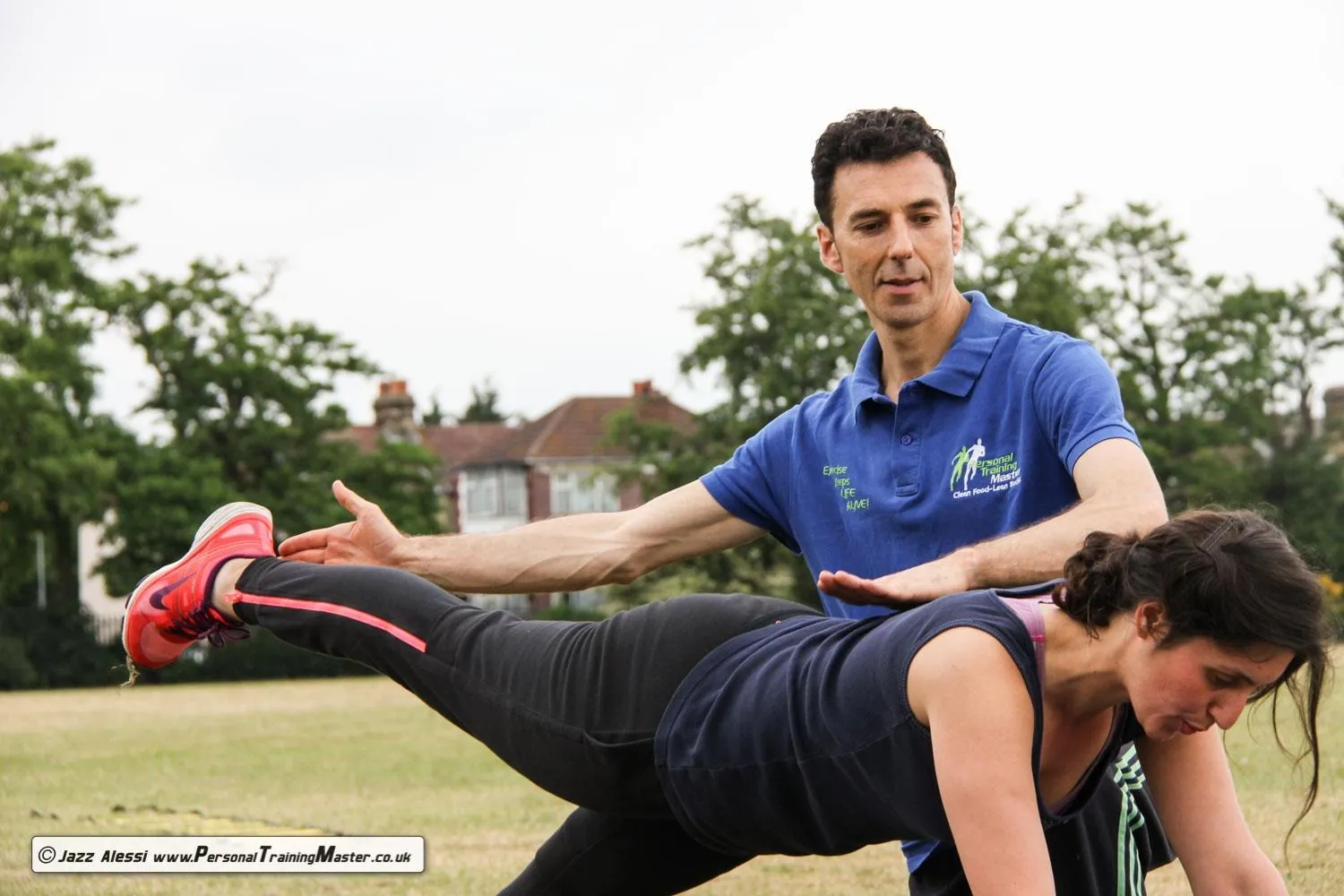
Pain reduction is not achieved simply by stretching tight tissue; it requires the restoration of strength in balance, ROM, functional symmetry, the elimination of compensatory movements and endurance, so that your lumbar spine becomes strong, agile and functional, no longer chronically overloaded, thereby ensuring that your back health transformation results are sustained over the long term,” continues Jazz.
Recovery is not One-Size-Fits-All - Because Your Back Is not Either
Effective lower back pain rehabilitation begins with careful medical history taking, back injury assessment, individualised strength, mobility and safe resistance training, applied in context to each part of the body.
Based on your rehabilitation goals, the muscles are worked both on their own and as part of functional, sport-specific and everyday movement. Clear, informed feedback throughout your rehab is essential.
Transformation Case Studies
Without these essentials, progress becomes slow and unpredictable, and recovery suffers.
The hidden cost?
Growing anxiety, stress, unnecessary risk and a gradual loss of productivity - often only apparent once performance, wellbeing and team efficiency are already affected.
So, what effects might result from applying this method in practice?
From Flare-Up to Transformation: How Elizabeth Regained Back Strength
“I have never been given exercises before that work both the upper and lower back together so effectively. Jazz has shown me how to train safely during a flare-up so that I can maintain strength. I was told it was too dangerous and my core was not strong enough. Now, I can sit up without using my arms to assist! In my personal experience, he provides rehab exercises more effectively than any physio.”
From Flare-Up to Taking Up a New Sport: Jan’s Back Rehabilitation Success
“My overall muscle tone, flexibility and training volume have increased by as much as 300 per cent which I did not expect. I built strength and endurance through training and doing way more than I thought possible. My back pain also diminished to a final reduction of 85-90 %. I could potentially take up a new sport, for example. Jazz commitment, knowledge and care are surely unsurpassable.”
Sitting Under Pressure: How London Office Work Strains the Lumbar Spine
Modern desk work creates predictable physiological stress patterns.
Sustained sitting diminishes gluteal muscle activation and increases dependency on passive spinal structures.
This contributes directly to lumbar spine strain.
Research published in The Lancet and the BMJ links extended sedentary time with elevated cardiovascular and metabolic risk, reinforcing broader sedentary lifestyle risks.
The prolonged sitting health effects extend beyond cardiometabolic outcomes to musculoskeletal loading patterns.
When the deep core deactivates, compressive forces through the lumbar discs increase. Reduced circulation slows tissue recovery, blood flow and nutrient recovery exchange.
The UK’s NHS guidance on back pain highlights posture, muscle weakness and inactivity as central drivers.
Over time, these combined ergonomic risk factors produce a pattern frequently described as lower back pain at work, a dull ache that gradually becomes persistent.
The body adapts to what it repeatedly experiences.
Unfortunately, the office chair has become the dominant stimulus.
The Hidden Productivity Drain: How Back Pain Undermines Workplace Performance.
Absenteeism captures only part of the impact.
Presenteeism, when employees attend work but function below capacity, often carries a greater cost.
ONS productivity data and Chartered Institute of Personnel and Development (CIPD) wellbeing surveys consistently show that chronic health complaints reduce concentration and engagement.
The productivity loss due to back pain frequently manifests as slower analytical processing, reduced tolerance for long meetings, and diminished creative output. In high-pressure sectors such as finance, even marginal cognitive drag compounds across teams.
According to NHS musculoskeletal statistics, back pain remains one of the most common reasons for GP consultation among working-age adults. When office-related back pain becomes persistent, it acts as a subtle but constant distraction.
Pain demands neurological attention. And attention, in knowledge industries, is capital.
Why Most Workplace Back Pain Solutions Fail to Deliver Lasting Change
Standing desks alone do not restore spinal stability. They may reduce sitting time, but without muscular endurance retraining, spine load distribution often remains inefficient.
Ergonomic chairs are temporarily protective, not corrective. They support posture but do not address underlying deconditioning. Generic stretching posters may temporarily relieve tightness but rarely rebuild resilience.
Sustainable change requires assessment-based lower back pain exercises designed to increase muscular endurance and restore movement symmetry. This often involves assessment-led programmes rather than one-size-fits-all advice.
If you live in the Central London or London Bridge area, a question increasingly asked by London professionals is: Could teaming up with the best Personal Trainer London Bridge provide the structured rehabilitation approach missing from standard workplace initiatives?
Back pain is rarely random. It reflects predictable mechanical overload patterns that require structured correction, not temporary relief.
What Truly Reduces Office-Related Back Pain: Strength, Stability and Load Tolerance
Evidence consistently supports targeted strengthening over passive intervention (Steffens et al., 2016). Effective lower back pain exercises prioritise:
Deep core activation to help transform core muscle weakness but, in a specific manner for your body movement patterns and goals
Controlled hip strength and hinge retraining
Progressive glute and deep spinal muscles strengthening
Gradual and customised load exposure to safely increase your spinal load tolerance
Restoring spinal stability reduces excessive segmental movement and distributes forces more evenly across the kinetic chain.
Rather than avoiding load, assessment-based modern herniated disc rehabilitation focuses on teaching the body to strengthen correctly and tolerate it safely.
The spine is designed for movement and strength, not prolonged immobility.
When endurance improves, pain often diminishes not through avoidance, but through capacity.
Musculoskeletal Health as Strategy: Why Prevention Outperforms Reaction
Reactive treatment is expensive. Prevention is strategic.
Structured workplace movement programmes cost significantly less than long-term rehabilitation, imaging, and extended absence.
Evidence from occupational health models across London suggests that early assessment and guided intervention reduce relapse rates and improve workforce engagement.
Addressing workplace back pain UK wide through proactive programming protects against chronic lower back pain at work, which otherwise escalates into long-term absence.
Prevention is not simply compassionate; it is financially rational.
Organisations that treat musculoskeletal health as performance infrastructure, rather than optional wellness, position themselves ahead of the curve.
From Pain to Real Back Health Transformation: Tackling London’s Office Back Strain
Behind every statistic is a professional sitting quietly in discomfort, concentrating harder than they should have to.
Back pain is not merely a health complaint. It is a national productivity constraint. It drains focus, slows strategy, and shortens careers.
The data is clear. The mechanisms are understood. The solutions are evidence-based.
London’s offices must move from reactive ergonomics to structured, assessment-driven movement strategies.
Because when we restore strength, endurance and symmetry, we do more than relieve pain.
We restore capacity, individual and economic alike.

Reviewed by