Choosing a dental implant clinic often begins long before a patient enters a treatment room.
A person with missing teeth, loose dentures, or several failing teeth may spend weeks researching options online. They may compare local clinics, watch treatment videos, read patient reviews, look at before-and-after photographs, and submit enquiry forms to several practices.
This research can be useful. A clinic’s website can reveal how clearly the practice communicates, whether the dentist is properly identified, and whether patients are given enough information to understand the next step.
However, a polished website is not proof of clinical quality.
Professional photography, confident language, impressive testimonials, and an attractive treatment page may influence how a clinic is perceived, but they cannot determine whether a patient is suitable for implants. They cannot replace an examination, appropriate imaging, diagnosis, informed consent, or an individualized treatment plan.
The most sensible approach is to use online information as an initial filter. It can help patients decide which clinics deserve closer consideration, which questions to ask, and when to seek another opinion.
Start by Identifying the Dentist
A dental implant page should make it easy to understand who will be responsible for the patient’s care.
The dentist’s full name should be clearly displayed. Patients should also be able to find information about qualifications, professional registration, relevant training, and experience.
This information should not be accepted automatically simply because it appears on the clinic’s website. Licensing and registration can often be verified through the appropriate professional regulator in the patient’s country or region.
Patients should also look carefully at how credentials are described.
Some clinics use phrases such as “implant expert,” “leading specialist,” or “internationally trained.” These descriptions may sound impressive, but they can be vague. A stronger website usually explains the dentist’s actual education, professional role, and the type of training completed.
It is also reasonable to ask who will perform each part of the treatment.
The person planning the implant placement may not be the same person performing the surgery or creating the final restoration. In larger practices, care may involve a general dentist, oral surgeon, periodontist, prosthodontist, dental technician, or another clinician.
This is not necessarily a problem. Dental implant care can involve several professionals. The important point is that the roles should be explained clearly.
Look for Explanations, Not Guarantees
Responsible dental websites explain treatment without promising that the same result is available to everyone.
Implant treatment depends on many individual factors. These may include the condition of the remaining teeth, available bone, gum health, medical history, smoking, previous treatment, medications, and the type of restoration being considered.
A clinic cannot know whether someone is suitable for implants based only on a website form or telephone conversation.
Patients should be cautious when a website appears to guarantee candidacy, healing, comfort, or permanent results before an examination has taken place.
Statements suggesting that treatment is completely painless, suitable for nearly everyone, or guaranteed to last for life may create unrealistic expectations.
A careful clinic will usually acknowledge that outcomes vary. It may explain that implant treatment can be highly effective in appropriate cases while also mentioning the need for assessment, maintenance, and long-term oral hygiene.
The presence of limitations does not make a clinic less capable. In many cases, responsible language is a sign that the practice takes informed consent seriously.
Check Whether the Consultation Process Is Explained
Patients often hesitate to book because they do not know what will happen during the first appointment.
A useful clinic website should provide a basic explanation of the consultation process. The exact steps vary, but an initial visit may include a discussion of the patient’s goals, a review of medical and dental history, an examination, photographs, scans, X-rays, or other appropriate imaging.
The dentist may also discuss different treatment options, likely stages of care, timing, fees, risks, and alternatives.
A clear explanation helps patients prepare without pretending that the final treatment plan is already known.
The website should also explain whether the initial appointment is purely a consultation or whether diagnostic procedures may take place during the same visit.
Patients may want to ask whether there is a consultation fee, whether imaging is included, and whether a written treatment plan will be provided afterward.
The more complex the proposed treatment, the more important it is that patients have time to understand what is being recommended.
Understand the Treatment Being Advertised
Dental implant terminology can be confusing.
A website may refer to dental implants, full-mouth implants, fixed teeth, implant-supported dentures, full-arch treatment, or same-day teeth. These phrases do not always describe the same treatment.
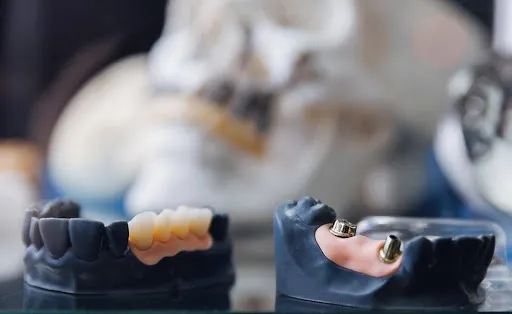
A single implant may replace one missing tooth. Several implants may support a bridge. Implants may also be used to stabilize a removable denture or support a fixed full-arch restoration.
Patients should not assume that every clinic offering “dental implants” provides the same range of care.
A good website should explain the differences in plain language. It should also avoid implying that one treatment is automatically superior for every person.
For example, a fixed full-arch restoration may be appropriate for some patients with widespread tooth loss or severely compromised teeth. Other patients may benefit from saving existing teeth, receiving a smaller bridge, using a removable option, or choosing a different form of treatment entirely.
These decisions should be based on clinical findings, not on which procedure is most heavily promoted online.
Review Before-and-After Photographs Carefully
Before-and-after photographs can help patients understand the kind of work a clinic performs, but they should be interpreted cautiously.
The first question is whether the images show the clinic’s own patients. Stock images or photographs supplied by manufacturers may look convincing without demonstrating the dentist’s own work.
The website should also respect patient privacy and indicate that images are used with appropriate consent.
When looking at photographs, patients can consider whether the lighting, angles, and image quality are reasonably consistent. Dramatic changes in lighting, facial expression, or camera position can make results appear more significant.
It is also worth asking what treatment was actually performed.
A photograph of a new smile may involve implants, crowns, bridges, veneers, gum treatment, or a combination of procedures. Without context, it may be difficult to know which part of the result is relevant.
Most importantly, photographs show appearance. They do not establish whether the treatment is functioning well, whether the patient experienced complications, or how the result has performed over time.
They also do not predict another patient’s outcome.
Read Reviews for Patterns
Online reviews are useful, but star ratings alone tell only part of the story.
Patients should look for patterns across multiple reviews rather than focusing on one extremely positive or extremely negative comment.
Useful themes may include how clearly the team communicated, whether fees were explained, how appointments were managed, whether patients felt pressured, and how the clinic responded when concerns arose.
Reviews discussing long-term follow-up may be more informative than comments written immediately after the first appointment.
Patients should also remember that no clinic is likely to have a flawless public record. A small number of negative reviews does not automatically mean the clinic provides poor care.
The content of the complaint and the clinic’s response may be more revealing.
A professional response should remain calm and protect patient confidentiality. Clinics should not reveal private medical information while defending themselves online.
Patients should also be cautious when a clinic has a large number of reviews that use nearly identical language or appear within an unusually short period.
Reviews are one source of information. They should be considered alongside credentials, consultation quality, treatment planning, and independent professional advice.
Examine Pricing Language Closely
Dental implant treatment can involve a significant financial commitment, so pricing is often one of the first things patients search for.
Some clinics publish detailed prices. Others provide ranges or starting costs. Some avoid mentioning prices until after the consultation.
Each approach has advantages and limitations.
A fixed headline price may be useful, but patients should ask what it includes. The advertised figure may cover only the implant placement, while excluding imaging, extractions, bone grafting, temporary teeth, sedation, the final restoration, or follow-up care.
A low monthly payment may also look attractive without showing the total amount repayable, the length of the agreement, or the financing conditions.
On the other hand, a clinic may avoid publishing one price because implant treatment varies significantly between patients.
This is not automatically a warning sign. The issue is whether the clinic explains the reason for the variation and provides a written estimate after assessment.
Patients should ask for a treatment plan that clearly lists what is included, what may create additional costs, and what happens if the planned treatment changes.
They should also understand whether future maintenance, repairs, or replacement components are included.
Evaluate the Quality of the Website’s Communication
A dental implant page should help patients understand the treatment and decide whether to arrange a consultation.
It should not rely entirely on slogans.
Useful pages usually explain who the treatment may help, what the consultation involves, who provides the care, and what patients should expect during the process.
The next step should also be obvious. Patients should know whether they are requesting a call, booking an assessment, or submitting their information for further contact.
Practices can use tools such as a free dental landing page analyzer to identify unclear headlines, missing information, weak explanations, and confusing calls to action.
A website audit can help evaluate communication quality, but it cannot assess clinical ability. A clear page is helpful because it allows patients to make a more informed initial decision, not because it proves that the treatment is medically appropriate.
Pay Attention to How the Clinic Responds
The first conversation with the clinic can reveal whether the website’s promises match the actual patient experience.
Patients should notice whether calls are answered professionally, whether questions are treated seriously, and whether the team explains the next step clearly.
Administrative staff should not diagnose patients or promise specific treatment before an examination. They should, however, be able to explain how the consultation works, what information the clinic may need, and how appointments are arranged.
Pressure is another warning sign.
Patients should be cautious if they are pushed to pay a large deposit immediately, discouraged from asking questions, or told that a special price is available only if they decide before receiving a full assessment.
Limited appointment availability may be genuine, and promotional offers are not automatically inappropriate. The concern arises when urgency is used to prevent the patient from thinking carefully or seeking another opinion.
A clinic providing complex treatment should be comfortable with informed questions.
Questions to Ask at the Consultation
Online research becomes most useful when it helps patients prepare better questions.
During the consultation, patients may want to ask:
-
What treatment options are available in my case?
-
Why are you recommending this specific option?
-
Are any of my existing teeth potentially restorable?
-
What examinations or scans are required?
-
Who will perform the surgical and restorative stages?
-
How many appointments are likely to be involved?
-
What risks and complications should I understand?
-
What happens if the implant does not integrate or healing is delayed?
-
Will I receive temporary teeth during treatment?
-
What maintenance will be required afterward?
-
What is included in the quoted price?
-
Are there suitable alternatives to implant treatment?
-
Would you advise getting another opinion?
The dentist should be able to explain the reasoning treatment?
-
Would you advise getting another opinion?
The behind the recommendation in understandable language.
Patients do not need to become dental experts, but they should understand enough to give informed consent.
Know When to Seek a Second Opinion
A second opinion can be valuable when treatment is extensive, expensive, irreversible, or difficult to understand.
It may be particularly sensible when a clinic recommends removing several teeth, rebuilding a full arch, or performing additional procedures such as bone grafting.
Patients may also want another opinion when two clinics provide very different diagnoses or treatment plans.
Different recommendations do not always mean that one dentist is wrong. Dentistry often involves more than one reasonable approach. However, the differences should be explained.
A patient should not feel embarrassed about seeking another view.
A responsible clinician will usually understand that complex treatment deserves careful consideration.
Another opinion may confirm the original plan, identify an alternative, or help the patient understand the advantages and disadvantages more clearly.
A Good Website Is Only the Beginning
A strong clinic website has real value.
It can introduce the dentist, explain treatment options, answer common questions, and make it easier for patients to arrange an appointment. It can also show whether the practice communicates in a clear, responsible, and patient-focused way.
But digital presentation is not medical evidence.
The quality of a website does not determine whether a patient has enough bone, whether remaining teeth can be saved, or whether a specific implant plan is appropriate.
Those questions require proper assessment.
The safest approach is to use online research to narrow the options, verify credentials, prepare questions, and recognize warning signs. The final decision should be based on clinical findings, informed consent, and confidence in the professionals providing the care.
Organizations such as Booked.Dental examine how dental practices communicate treatment and guide patients online, but even the clearest digital experience should lead to a proper diagnosis rather than replace one.
Patients should leave a consultation understanding what has been recommended, why it has been recommended, what alternatives exist, and what the treatment is likely to involve.
That understanding matters far more than an impressive homepage.

Reviewed by